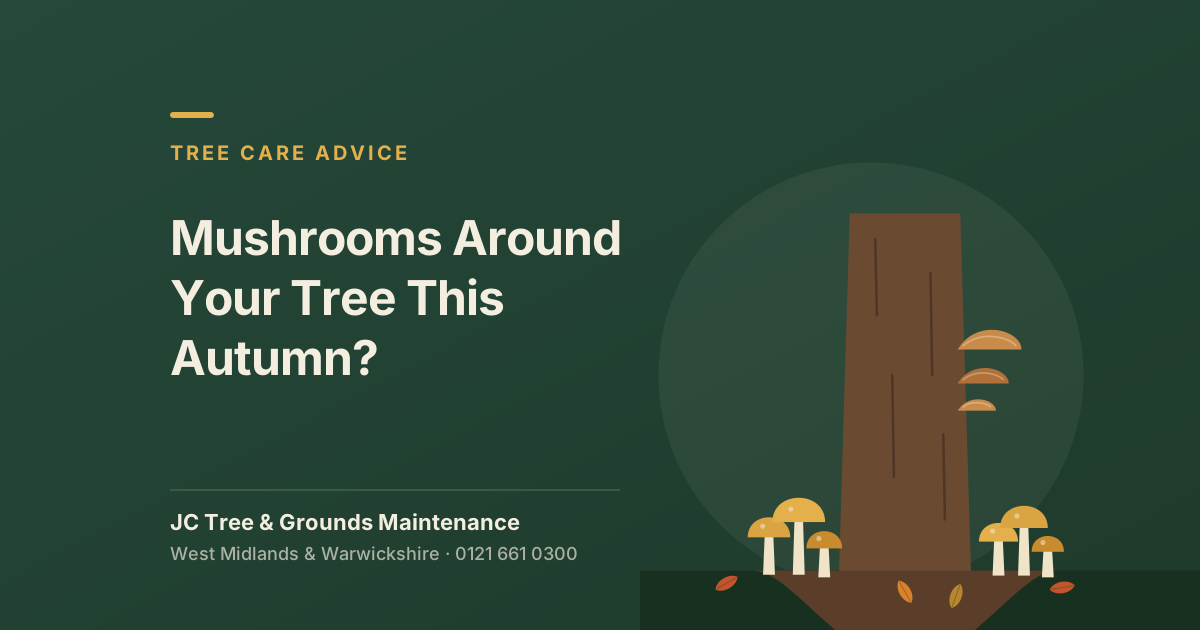
Autumn is mushroom season. From October onwards, it’s common to see toadstools popping up in lawns, around the base of trees, or even growing out of the trunk. Many are completely harmless. But some can be an early warning that a tree is decaying from the inside and could become unsafe. Here’s how to tell the difference.
Why do fungi appear in autumn?
Most fungi live hidden in the soil or inside wood all year round. The mushrooms you see are just their fruiting bodies, which appear when conditions are cool and damp to release spores. That’s why they suddenly appear in large numbers in October and November.
Harmless fungi
Many fungi are good for your garden. Some break down dead leaves and wood, returning nutrients to the soil. Others form a helpful partnership with tree roots, helping the tree take up water and nutrients.
Mushrooms scattered across a lawn, a little way from any tree, are usually nothing to worry about.
Fungi that can signal a problem
Be more cautious if you spot fungi:
- Growing directly on the trunk, especially bracket-shaped fungi sticking out like shelves
- Clustered at the base of the tree, around the root flare
- On or around an old stump near other trees and shrubs
- Alongside other warning signs, such as dead branches, thinning leaves, cracks or a new lean
Fungi in these places can mean the wood or roots are decaying. Decay weakens a tree’s structure, sometimes without much sign from the outside, and can make it more likely to drop branches or fall in high winds.
Honey fungus: one to watch
Honey fungus is one of the most damaging fungal diseases in UK gardens. In autumn, look for:
- Clumps of honey-coloured toadstools at the base of trees, shrubs or stumps
- A white, papery layer under the bark near ground level, often with a strong mushroom smell
- Black, bootlace-like strands in the soil or under the bark
Honey fungus spreads underground from infected roots and old stumps, and can attack other trees and hedges nearby. Removing infected stumps is one of the best ways to slow it down. Our stump grinding service can help clear old stumps before the problem spreads.
What should you do if you find fungi on a tree?
- Don’t panic. Fungi alone don’t always mean a tree is dangerous.
- Take a photo. Note where the fungi are growing and how big they are. Mushrooms often disappear within days, so a photo helps a tree surgeon identify them later.
- Look for other signs. Check the tree for dead wood, cracks, cavities or root damage.
- Get a professional opinion. If the tree is large or near your house, a road, a play area or a neighbour’s property, ask a qualified arborist to inspect it.
How we can help
A tree survey is the best way to find out whether fungi are a sign of serious decay. Our qualified team will assess the tree’s condition and recommend the right course of action. That could be monitoring it, removing affected branches, reducing the crown or, if the tree is unsafe, felling and removing it.
With winter storms on the way, now is the ideal time to get any concerns checked.
JC Tree & Grounds Maintenance covers Solihull, Coventry, Nuneaton, Birmingham, the West Midlands and Warwickshire.
Book a tree inspection or call us on 0121 661 0300.